

Is Imagination Dead?
The Architecture of Our Domestication

Why we are trading our vibrant inner cinema for a five-inch predictive box—and how to reclaim the right to dream.
We’re saturated, living in a packaged world. A loud, crowded, and completely finished world, leaving us little to no space to fill it with our own feedback and creations. From the moment we wake up, our attention is automatically pulled to a screen that tells us what to think, what to buy, and even what to dream. We may call this “progress,” but for the human spirit, it feels more like decadence. Something inside us feels as if it has receded: our ability to imagine, to see beyond what the five senses can perceive. We’ve traded our own internal cinema for a five-inch predictive box we carry even to our bed. And we’re raising a generation of children who may know how to consume a world, but are rapidly losing their ability to create one.
Is imagination dead? Or have we simply been trained to see our greatest power as a distraction? Have we been conditioned to trade our vibrant, chaotic inner creative engine for a world that is efficient, fast, and grey? Have we been tricked into relinquishing our ability to create in favor of a world that thrives on our consumption?
I remember watching my child a few years ago inhabiting a universe where a cardboard box was a starship and a backyard was a paleontology site for him to dig out dinosaur fossils. Like any child, he lived in a state of constant discovery and messy creation. As he’s grown older, more and more he seems to be consumed by a world that demands him to consume.
Becoming an adult has always been equated with being “realistic.” We’re pressured to swap that kaleidoscope for a spreadsheet. We’re told that imagination is just a cute phase to be outgrown, rather than what it truly is: our primary power as humans to rewrite the stories of our lives. Nowadays, I often find myself telling my teenage son to stop looking at the screen and start creating something; anything: music, a drawing, or if nothing finds space, to simply get bored. Because when we allow our imaginative fire to go out, we stop being the architects of our own reality. We become little more than biological robots, following a pre-written script in a world we no longer feel we have the power to change.
The Systems of Predictability
We aren’t born boring; we’re domesticated. Our imagination is a “wild” thing, and the systems we’re born into hate what they can’t predict. Even more, they hate what can’t be contained and controlled.
From a very young age, children are immersed in the School System, which functions like a factory for the “Right Answer.” Schools were originally designed to create good factory workers, people who show up on time and follow instructions. They reward reproduction and compliance, not creation. If you can repeat what the teacher said, you get an A. If you imagine a different way to solve a problem, you’re told you didn’t follow directions. This system doesn’t just teach facts; it teaches us to fear the error.
But imagination requires the error. It requires the messy, slow process of being wrong until you find something new. When mistakes are penalized, we aren’t just creating good students; we’re killing the explorer, the inventor, and the dreamer. We learn to stop looking for our own truth and start looking for the teacher’s truth, who then becomes the boss, the government, and ultimately the global structures we’re forced to fit into. By teaching us that facts are above imagination, school trains us to categorize the world before we’re allowed to experience it.
This is usually reinforced by the Family System. Well-meaning parents often kill imagination out of fear. By reinforcing the belief that we need to be practical, they think they’re helping us survive in the real world. And they’re right. That’s how the world is designed. Family conditions us for survival by telling us to stop daydreaming. As we internalize the idea that our imagination is a danger to our success, we start to believe that being a full human is less important than being a worker. Our “What Ifs” turn into “How Wills” the moment our survival depends on them.
As we grow up, the Economic System takes over, demanding efficiency. Imagination, again, is seen as a luxury or a waste of time because it doesn’t produce measurable results. It doesn’t feed the machine that keeps the world spinning. We become functional, but flat. Under the weight of survival and the constant pressure to be productive, our minds lose their ability to wander. Our brain shuts down its creative center to focus on the immediate “Now.” We realize it’s very hard, even irresponsible, to be a dreamer when we have to worry about our next meal.
Imagination requires the luxury of psychological safety, and many can’t afford it because it’s taken away by economic scarcity. That’s the greatest theft of the poor. The system keeps us so busy and so tired that we don’t have the energy to imagine a better world. We only have the energy to survive the one we’re in.
Read more on how economic survival suffocates the soul in Poverty is a Jail.

Finally, Technology, the very thing that claims to give us more, has become a way to outsource our inner lives. Algorithms curate our taste and answer our questions before we even finish asking them. We’ve traded the friction of creating for the ease of consuming. By feeding us back only what we already know, this digital mirror starves our imagination, taking away our capacity to wonder. It gives us “imagination-in-a-box.” We don’t have to wonder what a dragon looks like; we can just watch a movie. Children don’t have to invent new games; they can just download them. Our internal creative muscles go soft. We become like people who are fed through a tube; we forget how to chew, how to cook, and how to feed ourselves.
The goal of these systems is to make us predictable. A person with a wild imagination is dangerous to a system because they can’t be controlled. They might imagine a different way to live, a different way to work, or a different way to be free.
How to Reclaim Our Right to Dream
With my son, I see that when the screen goes off, the complaints of boredom begin. And I want him to be bored. Boredom is not a problem to be solved; it’s the very soil where the seeds of our creations are planted. It’s the empty space where the mind is forced to catch fire.
In a world that provides instant validation, the slow and ambiguous act of imagining feels uncomfortable. We’ve lost our tolerance for uncertainty. Yet, it’s only in that uncertainty that the Human begins to emerge. To tell a child to sit in the silence is to give them back the keys to their own kingdom. The same applies to us.
Even when we have been conditioned to believe that we are helpless, that we have no recourse but to abide by the demands of the systems that have molded us, throughout history, humans have reclaimed their right to dream and have tried to teach us to do the same. The masters of history knew that facts were just the hardware; imagination is the power that actually shapes reality. Let’s remember just a few examples:
Albert Einstein famously said, “Imagination is more important than knowledge.” Knowledge is a map of a road someone else already walked. Imagination is the only thing that can show us a road that doesn’t exist yet. Einstein didn’t find the laws of the universe by following the “correct” answers; he found them by imagining himself riding on a beam of light.
Neville Goddard took this further into the heart of our identity. He believed imagination is the ability to assume a new state of being before it’s visible. When we imagine who we want to be, we aren’t faking it; we’re rehearsing our future. If the system can narrow what you imagine, it can narrow who you become.
William Blake warned us against “Single Vision,” the habit of only seeing the world as a cold, physical machine. He believed we should see through the eye, not just with it. Without imagination, a tree is just lumber and a person is just a worker. With it, the world becomes a miracle again.
The Rebellion of the Dreamer
We must ask ourselves: What kind of humanity emerges when we stop asking “What if?”
A society that doesn’t imagine is a society that accepts “what is” as inevitable. Every great change in history, every act of freedom and justice, started as an impossible thought in someone’s mind. When we lose our imagination, we lose our ability to say: “This could be different.”
Imagination is not dead. It’s just sub-utilized, buried under the noise of a world that wants us to be predictable. Reclaiming it is an act of rebellion. It’s not about being a “creative” or an “artist”; it’s about being a full human.
Let’s put down the packaged world. Sit in the silence. Let the boredom burn until it turns into a flame. We don’t need more answers; we need better questions. Our sovereignty depends on our ability to see what isn’t there… yet.
Closing Note: If this resonated with you, try a small experiment today: Give yourself ten minutes of “unproductive” silence. No phone, no music, no plan. See what your mind builds when it’s finally allowed to be the architect again.
Imagination is the engine of human sovereignty. If we lose the ability to imagine “otherwise,” we cease to be the protagonists of our own lives and become mere data points.
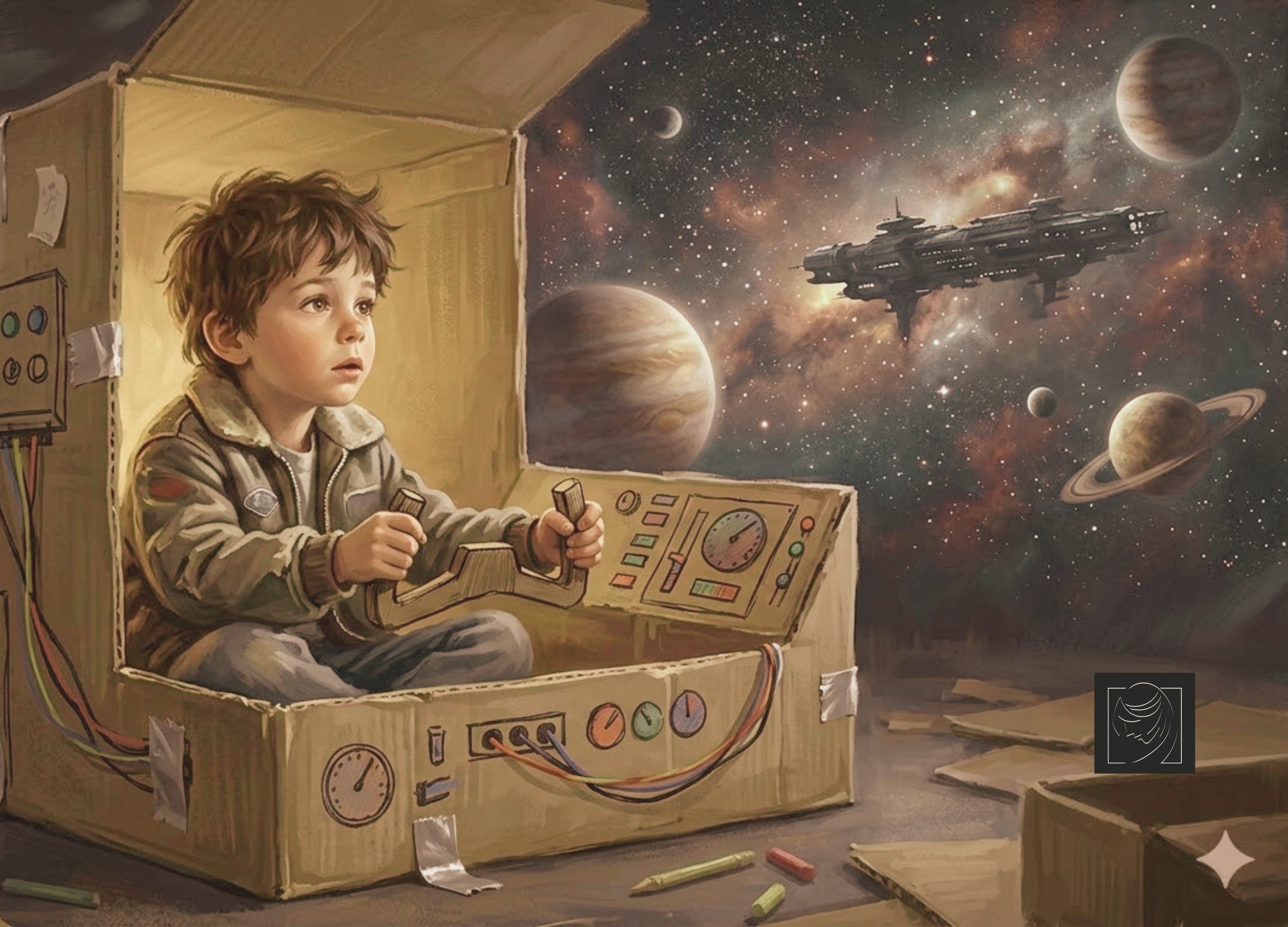
What was the last thing you imagined before the world told you to be 'realistic'?
I raised my children without the internet.
Today I am a witness to my grandchildren plugged into their phones and iPads.
It is not a better world for those constantly plugged in to these devices!
The parents who allow it, I feel use it as a babysitter to keep the children entertained.
My son has 2 children ages 6 and 4 who are unplugged out of the 9 grandchildren. Building Legos, dancing, playing and learning to read and write. I see a difference in their curiosity for life.
I easily unplug from my phone throughout my day.