

Poverty Is a Jail
An opening reflection for Human First Journal

Human First Journal begins from a simple premise: our humanity is at the center of experience. These essays are written from lived experience and reflection, attending to the ways beliefs, structures, and inherited narratives obscure what it means to be human and shape our sense of possibility. This is not a manifesto, but a journal. A place to witness, feel, and question from a human perspective.
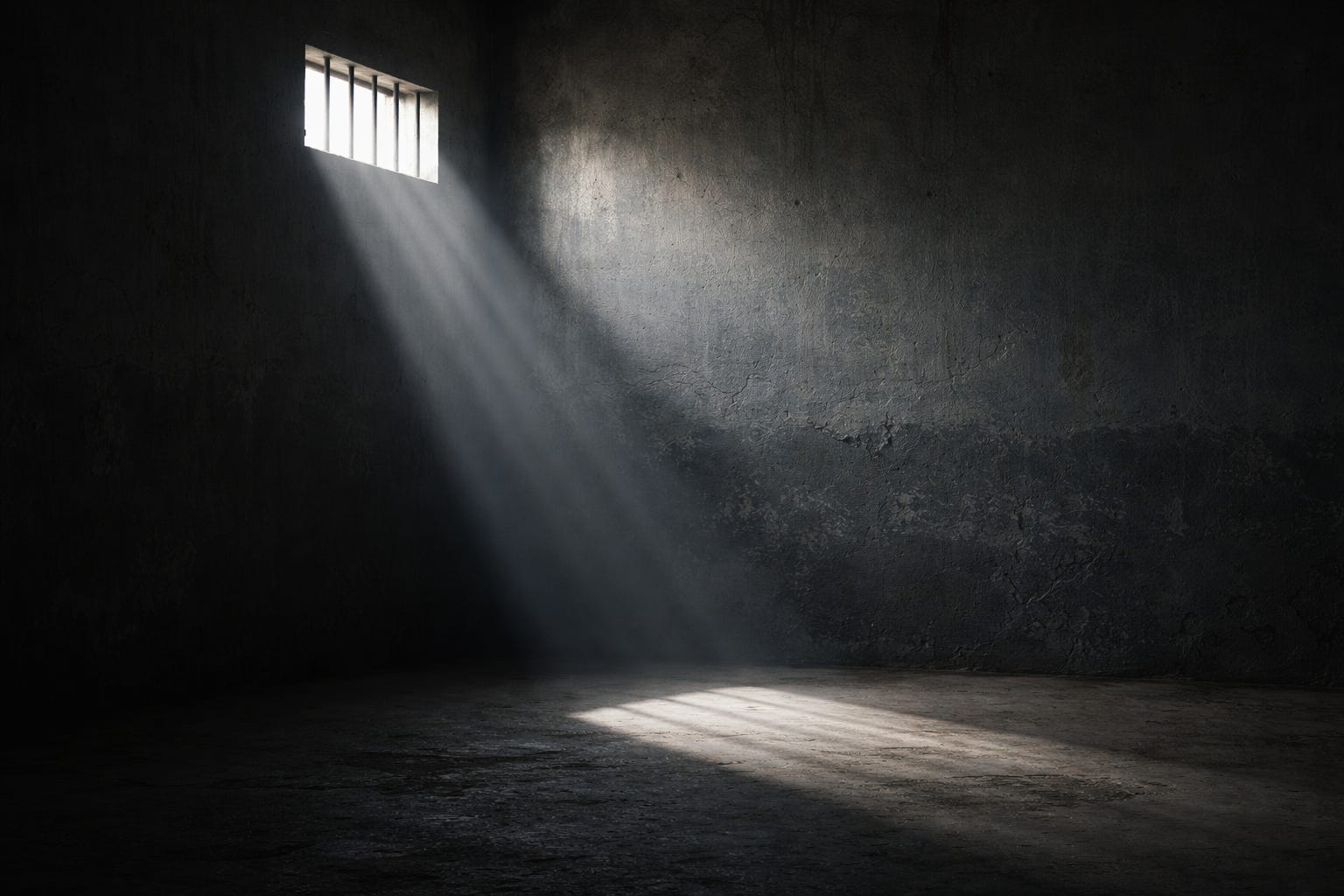
Poverty is a jail—often disguised as a lack of virtue, a failure of character, or even a spiritual lesson masked as humility.
No. It is a jail.
I write this as someone who grew up in poverty; as someone who continues to ask why; and as someone who experienced firsthand the conditioning that frames poverty as a virtue. I also write as a person who is finally opening my eyes—one who is beginning to notice the system, the lack of awareness, the inherited beliefs, and the social enforcement that keep so many people trapped.
For a long time, I sensed that something was wrong. Things did not add up. I saw hardworking people struggling and intelligent people barely making ends meet. Even when I could recognize the misalignment intellectually, I could not name it. Now, as the invisible bars surrounding me and others have become visible—almost tangible—they feel oppressive, asphyxiating, undeniable… and breakable. This visceral realization has ignited a desire to strip poverty of its mysticism.
Here is what I know about poverty as a jail.
Poverty is not an individual failure story, and it is not only about money. Money—or the lack of it—is merely a mechanism used to keep people trapped. Poverty is a system, built to strip us of sovereignty and freedom, using our need for survival as its foundation.
One of the first freedoms this system takes is our freedom over time. Time no longer belongs to us; it belongs to the system that keeps us setting alarms, clocking in and out, and trading minutes for coins. Life force is spent doing what is necessary to pay the bills. Leisure becomes undeserved, because poverty makes everything urgent and nothing sacred.
This is not accidental. A system that depends on exhaustion cannot allow clarity or expansion. A world built on extraction requires people who are too tired to become aware, let alone question the structure they are sustaining.
So how does the jail get inside the person?
Like many prisons, poverty’s walls are both external and internal. There are systems, yes—but there are also the pervasive beliefs that form when doors remain closed long enough, allowing the jail to persist without visible force. How can we resist a prison we believe to be reality?
These beliefs are not proof of ignorance. They are evidence of conditioning—conditioning that convinces us we have no real choice, that this is simply how life is. The message is so persistent and inescapable that we begin to wear it as part of our identity. Choice disappears and is replaced with calculation.
These beliefs strip us of imagination. They teach us to shrink our desires until they fit within what is deemed “realistic.” We hear phrases like: We can’t afford that. That’s not for people like us. Dreaming becomes irresponsible. Asking becomes shameful. Wanting more is framed as a betrayal of humility.
When imagination becomes a casualty, creativity follows. We may continue to create, but under the belief that creativity does not pay the bills or put food on the table. As a result, many creatives are forced to choose between poverty and abandoning their drive to create. Creativity is permitted only when it does not threaten survival.
The perpetuation of these beliefs narrows our field of vision. God forbid we see beyond the bars. In my case, I limited myself so deeply that envisioning a larger future—even a larger prison cell—became difficult. My nervous system recoils at big dreams or reaching for more. That feels dangerous. The cell, though uncomfortable, is familiar. Confinement feels safer than imagined freedom.
In this way, the system extracts our will, tampers with our imagination, and keeps us small through beliefs that are not chosen but installed. These beliefs become the bars we unknowingly help maintain. Yes, we do. We remain trapped because we are unaware that we are and because those beliefs are so incarnated that they dictate our actions and outcomes.
And when awareness does emerge, it often brings ridicule, isolation, and the threat of lost belonging. Families and communities—often unintentionally—place limits on attempts to break free. We hear: Who do you think you are? or Don’t get unrealistic. Success can mean exile, and across generations we have been conditioned to perceive exile as a threat to survival. Staying, then, becomes a strategy.
Poverty also disguises itself as dignity, virtue, and even righteousness. I spent my teenage years surrounded by nuns. I remember the dignity with which they upheld their vows of poverty, the pride they took in renouncing material possessions to serve Jesus. I learned early that it would be easier for a camel to pass through the eye of a needle than for a rich person to enter heaven.
Religious programming has historically been one of the tools used to keep people in poverty. This is not a condemnation of religion as a whole, but of teachings that have led many to believe they are unworthy of embodying heaven while alive. Dignity does not require deprivation; consciousness does not demand scarcity; and liberation can be aspired to within a lifetime.
Naming poverty as a jail does not deny resilience or strength. Surviving these conditions requires intelligence, endurance, and adaptation. What it refuses is the confusion of worth with struggle, the praise of endurance while injustice remains unexamined, and the acceptance of cages as character-building tools—or worse, as inevitable destinations in our passage through life.
When we recognize that this prison is made of both internal and external walls—intentionally designed, unconsciously maintained, and unintentionally enforced—we can stop being grateful for the bars. We can begin to name them. And what can be named can begin to be dismantled.
💯 difficult truths
This is so good, I'm subscribing hoping for more content like this! Thanks!